
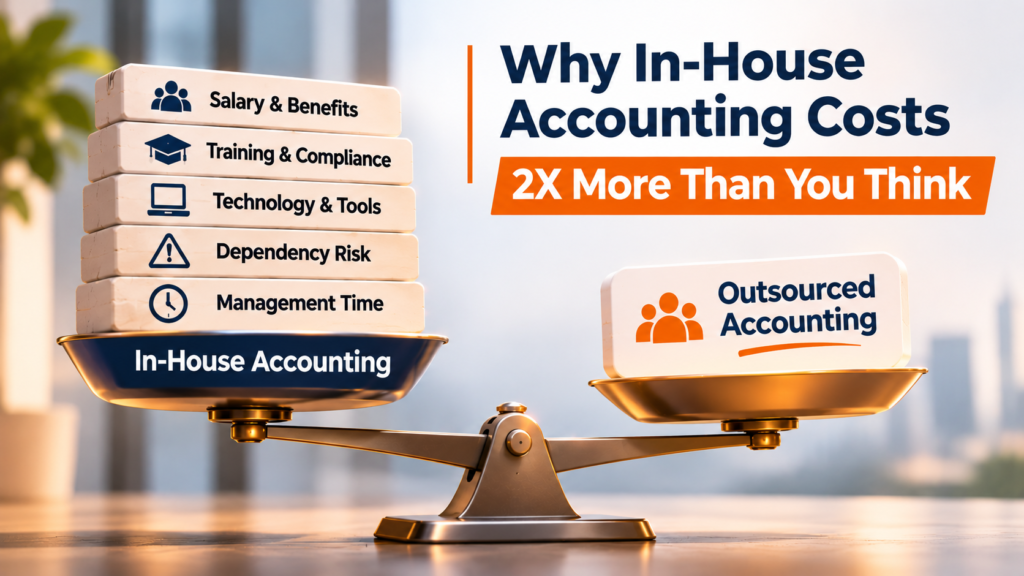
In-house accounting costs are often much higher than businesses initially expect. Many businesses assume that maintaining an in-house accounting team is the most cost-effective and controlled approach. On the surface, a fixed salary and internal supervision may seem efficient. However, when you look beyond basic payroll costs, in-house accounting often costs nearly twice as much as expected..
At IndoAdvisors, we regularly work with growing businesses in India, New York, and London that discover this hidden financial burden only after scaling. Here’s why.
1. Salary Is Only the Beginning
The most obvious cost is salary—but it’s far from the full picture.
In-house accounting expenses also include:
- Recruitment and onboarding costs
- Annual increments and bonuses
- Employer PF, gratuity, insurance, and benefits
- Paid leaves and non-productive hours
When calculated annually, the true cost of an in-house accountant can be 1.5–2X their salary.
These additional expenses make in-house accounting costs significantly higher than the basic salary businesses initially budget for.
According to the U.S. Bureau of Labor Statistics’ June 2026 data, employee benefits accounted for 30% of total compensation costs for private-sector workers in the United States. This demonstrates why businesses should consider benefits and other employment expenses when calculating the true cost of an in-house accounting team.
2. Training & Skill Upgradation Costs
Accounting standards, tax laws, and compliance requirements change frequently—especially for businesses operating internationally.
In-house teams require:
- Continuous professional training
- Updates on GST, Income Tax, IFRS, GAAP, and regulatory changes
- Software and compliance certifications
These ongoing costs are often overlooked in budgeting, yet they are essential to avoid compliance risks.
For businesses operating across multiple markets, these training requirements further increase in-house accounting costs.
3. Limited Expertise, Higher Risk
An internal accountant may be strong in one area but limited in others—such as:
- International taxation
- Cross-border compliance
- CFO-level financial strategy
- Advanced MIS and forecasting
This knowledge gap can lead to:
- Compliance penalties
- Missed tax-saving opportunities
- Poor financial decision-making
The cost of errors can be far greater than the cost of expert advisory support. When businesses lack access to specialized expertise, in-house accounting costs can increase through compliance errors, missed opportunities, and additional advisory expenses.
4. Technology & Infrastructure Expenses
Modern accounting requires secure, scalable, and compliant systems.
In-house accounting demands:
- Accounting software licenses
- Data security infrastructure
- Backup systems and IT support
- Compliance with data protection standards
Outsourced firms like IndoAdvisors already invest in enterprise-grade tools and security, spreading the cost across clients—saving you money. Software subscriptions, cybersecurity, and IT maintenance are important components of total in-house accounting costs.
5. Dependency Risk
What happens when your key accountant:
- Takes extended leave
- Resigns unexpectedly
- Is unavailable during audits or deadlines
This dependency creates operational risk and often leads to costly last-minute hiring or consultant fees.
Outsourced accounting eliminates single-point dependency by providing team-based continuity.
6. Management Time = Hidden Cost
Senior management spends valuable time:
- Reviewing accounting work
- Resolving compliance issues
- Coordinating audits and filings
This time could be better spent on business growth, strategy, and revenue generation—an often ignored but very real cost.
Including management hours in the calculation gives businesses a more realistic picture of their in-house accounting costs.
How In-House Accounting Costs Add Up
To understand the actual financial impact, businesses should look beyond an accountant’s monthly salary. Calculate the annual salary, employer contributions, recruitment expenses, training, software subscriptions, IT infrastructure, and management time spent supervising accounting operations.
For example, hiring an accountant may appear affordable based on the proposed salary. However, once employee benefits, technology, professional development, and operational overheads are included, the total annual expense can increase significantly.
Businesses should also consider the cost of replacing employees, maintaining continuity, and addressing compliance mistakes. A proper cost comparison helps business owners evaluate whether maintaining an internal team or choosing outsourced accounting services offers better long-term value.
In-House Accounting Costs vs. Outsourced Accounting
Outsourcing accounting and CFO services provides:
- Access to multi-domain expertise
- Predictable and scalable costs
- Better compliance and risk management
- Advanced reporting and strategic insights
With IndoAdvisors, businesses gain a full accounting and CFO team at a fraction of in-house costs—without compromising control or quality.
Final Thoughts
In-house accounting may appear affordable, but once hidden costs, risks, and inefficiencies are considered, it often costs twice as much as expected.
If your business is scaling or operating across borders, outsourcing to a trusted advisory partner can be a smarter, safer, and more profitable decision.
Looking to Reduce Accounting Costs Without Compromising Quality?
Partner with IndoAdvisors for expert outsourced accounting, taxation, and CFO services tailored for businesses in India, New York, and London.